Guilin is located in the northeastern part of the Guangxi Zhuang Autonomous Region. Renowned worldwide for its "finest mountains and waters under heaven," it is one of the first national historical and cultural cities and a world-class tourist destination. The karst landforms here create the breathtaking scenery described in the verse, "The river winds like a blue silk ribbon, while the mountains resemble jade hairpins." Attractions such as the Li River, Elephant Trunk Hill, and the Two Rivers and Four Lakes leave visitors spellbound.
Guilin is not only endowed with stunning landscapes but also boasts a unique local culture and customs. The region is home to diverse ethnic groups, including the Zhuang, Han, Miao, Yao, and Dong peoples, each contributing to a rich tapestry of folk traditions. Vibrant cultural events such as the Zhuang's March 3rd Song Fair, the Dong's Grand Chorus, and the Miao's Lusheng Festival are full of distinctive charm. The people of Guilin are warm and hospitable, living at a leisurely pace, with the tranquil essence of the landscapes permeating every street and alley.
When it comes to Guilin cuisine, the most famous is undoubtedly Guilin rice noodles, celebrated for their smooth, silky texture and savory spiced broth. Other local delicacies include beer fish, Lipu taro braised pork, stuffed snails, water chestnut cake, and osmanthus cake, as well as souvenirs like osmanthus tea and Guilin Sanhua liquor, all of which leave a lasting impression on the palate.
200m from the hotel, with views from the hotel
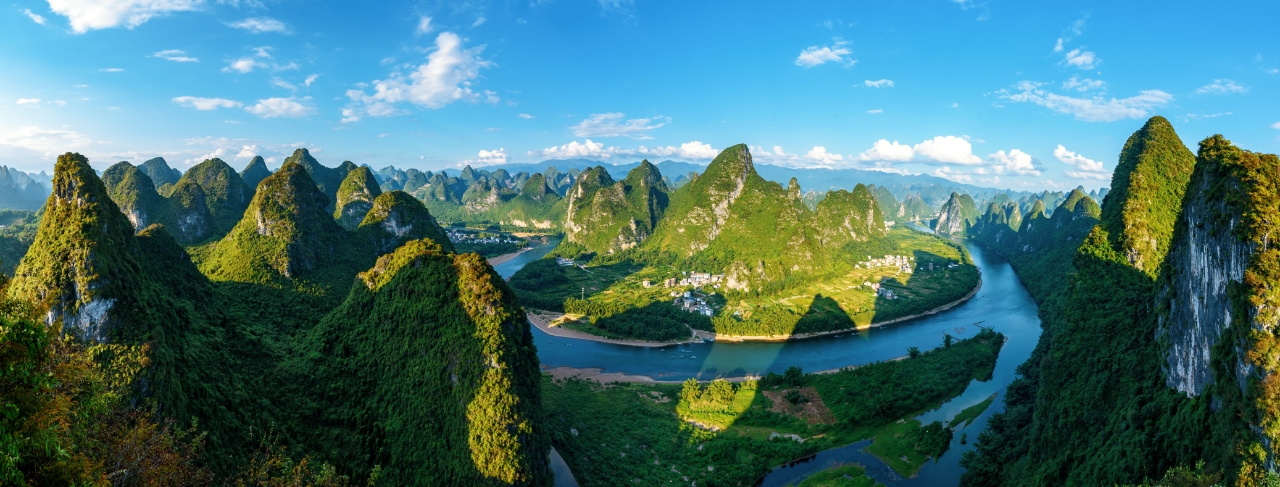
The Li River winds like a jade ribbon across the magical landscape of Guilin, Guangxi, a masterpiece of nature's extraordinary craftsmanship. It originates from Mao'er Mountain and flows onward, eventually joining the Xi River. A boat trip along the Li River feels like stepping into an endless scroll of landscape paintings.
Strange and magnificent peaks line both banks in a variety of shapes — some like swords piercing the sky, others like camels drinking by the river's edge, and still others like graceful maidens standing tall. Under the gentle touch of sunlight, the mountains display a beautiful interplay of light and shadow. The river water is crystal clear, revealing fish darting among the stones and the colorful pebbles beneath. Green mountains reflect in the water, the river taking on their verdant hue while the reflections bring the hills to life, creating a poetic and picturesque scene of intertwined hills and waters.
701m from the hotel, with views from the hotel
The iconic landmark of Guilin's landscapes AAAAA-Level Scenic Area
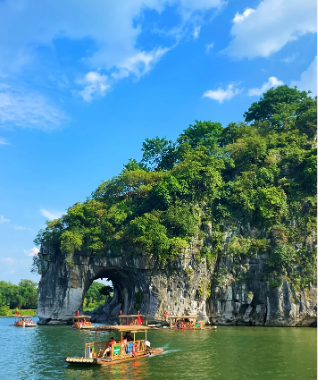
Elephant Trunk Hill, formerly known as Li Hill, is located at the confluence of the Taohua (Peach Blossom) River and the Li River in Guilin. It gets its name from its striking resemblance to a giant elephant standing by the riverbank, extending its trunk to drink from the clear waters of the Li River. The hill is renowned for its wonder. Firstly, its shape is remarkably lifelike, and secondly, between the trunk and the legs lies a moon-shaped cavern that forms the famous "Elephant Hill Water Moon" spectacle. As the emblem of Guilin, Elephant Trunk Hill is the symbolic landmark of Guilin tourism. It sits at the confluence of the Li River and Taohua River in the city center, shaped like a giant elephant with its trunk reaching into the water. The round cavern between the trunk and legs covers an area of about 150 square meters, with river water flowing through it, resembling a bright moon floating on the water. The Water Moon of Elephant Hill on the west bank faces the Chuanyue Rock on the east bank of the Li River — one hanging in the sky, the other floating on water — creating the extraordinary "Twin Moons of the Li River" spectacle.
Located right next to the hotel, with views at any time
The most beautiful ring of scenery in Guilin's city center AAAAA-Level Scenic Area
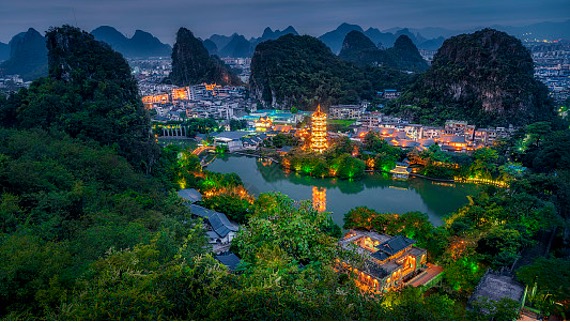
The Two Rivers and Four Lakes refers to the city's encircling water system comprising Rong (Banyan) Lake, Shan (Fir) Lake, Gui (Osmanthus) Lake, Mulong (Wooden Dragon) Lake, the Li River, and the Taohua (Peach Blossom) River. The interconnected waterways form the most scenic ring of landscapes at the heart of Guilin.
Water tours of Guilin date back to the Tang Dynasty and flourished during the Song Dynasty. At that time, the city was dotted with lakes and ponds with an extensive water network, allowing one to take in all the scenic landmarks of the city from a small boat. Today, the Two Rivers and Four Lakes water system has revived its former glory, creating a ring of waterways comparable to the city of Venice in Italy — truly a unique wonder of China.
Guilin is a quintessential landscape city, where natural scenery forms the fundamental element of its urban landscape. The Two Rivers and Four Lakes Scenic Area authentically embodies the beautiful vista of "a thousand peaks standing in the wild, one river embracing the city" and the poetic charm of "the city within scenery, and scenery within the city."
1km from the hotel
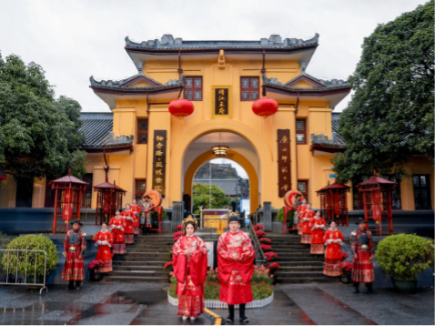
A tourist attraction themed around history and culture AAAAA-Level Scenic Area
The Duxiu (Solitary Beauty) Peak & Princes' City Scenic Area is located on the banks of the Li River, centered around Duxiu Peak — the "King of All Peaks" in Guilin — and built at its foot. The scenic area encompasses the site of the Ming Dynasty Jingjiang Princely Residence as its core. Here you will find the best-preserved Ming Dynasty city walls in China and the most completely preserved Ming Dynasty princely residence. "Read the Princes' City, and you will know Guilin." The Jingjiang Princely Residence was first built in the fifth year of the Hongwu reign of the Ming Dynasty (1372), a full 34 years earlier than the Forbidden City in Beijing.
693m from the hotel
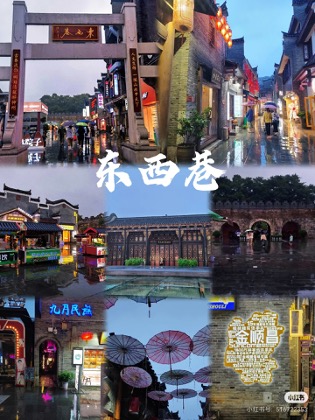
This historic alley has witnessed nearly 1,400 years of Guilin's rise and fall ever since the city was established during the Wude reign of the Tang Dynasty.
It is the most well-preserved ancient street district in Guilin's main urban area, encompassing traditional Guilin streets and lanes such as Zhengyang Street East Alley, Jiangnan Alley, and Jing Alley.
1.1km from the hotel
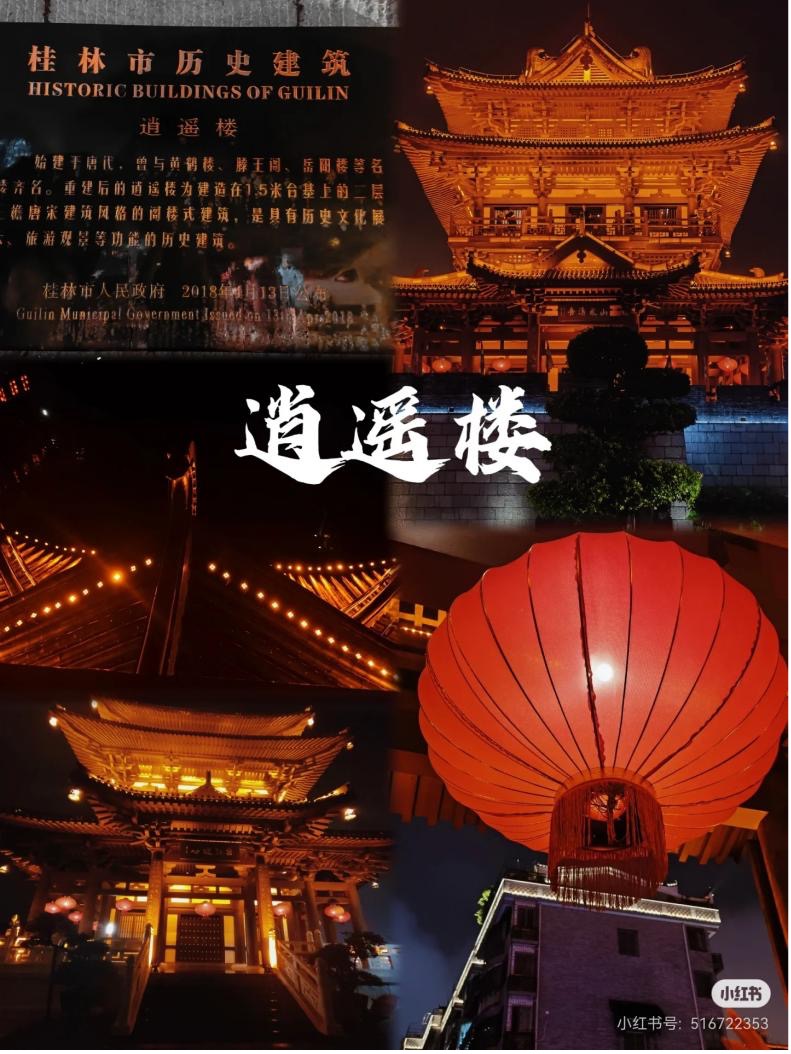
Xiaoyao Tower in Guilin is a hidden gem offering panoramic views of the essence of the Li River! First built during the Tang Dynasty and supervised by the renowned general Li Jing, its name derives from Zhuangzi's "Xiaoyao You" (Free and Easy Wandering), and it once housed a stele inscribed by the celebrated calligrapher Yan Zhenqing, giving it profound historical depth. The present tower was rebuilt in 2015 in the Tang and Song architectural style and is truly magnificent. It was once ranked alongside the Yellow Crane Tower and the Prince Teng Pavilion.
By day, with its vermilion pillars and blue-tiled eaves, it adds a touch of ancient elegance to the ink-wash painting of Guilin. By night, as the lights come on and the tower glows in resplendent gold, it feels as though one has traveled back to the golden age of the Tang Dynasty. Ascending the tower, you can gaze eastward at the bustling Liberation Bridge and westward at the lush greenery of Duxiu Peak, taking in both Guilin's natural beauty and urban scenery at a glance. Xiaoyao Tower is more than just a viewing platform — it is a testament to Guilin's thousand-year cultural heritage.
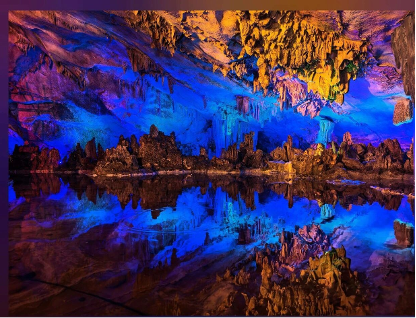
Reed Flute Cave is a national 4A-level scenic area located on the hillside of Guangming Hill beside the Taohua (Peach Blossom) River in Xiufeng District, Guilin, approximately 5 kilometers from the city center. It was the filming location for the "Dragon Palace of the Eastern Sea" in the 1986 TV adaptation of "Journey to the West." Having hosted over a hundred foreign heads of state, including Richard Nixon, it is known as the "Cave of National Guests" and is the most renowned karst cave in Guilin. The cave is named after the reeds growing at its entrance, which can be made into flutes.